
The Hidden Profit in Concrete Yield: How Grade Control Protects Your Bottom Line
By Luke Williams · · Updated
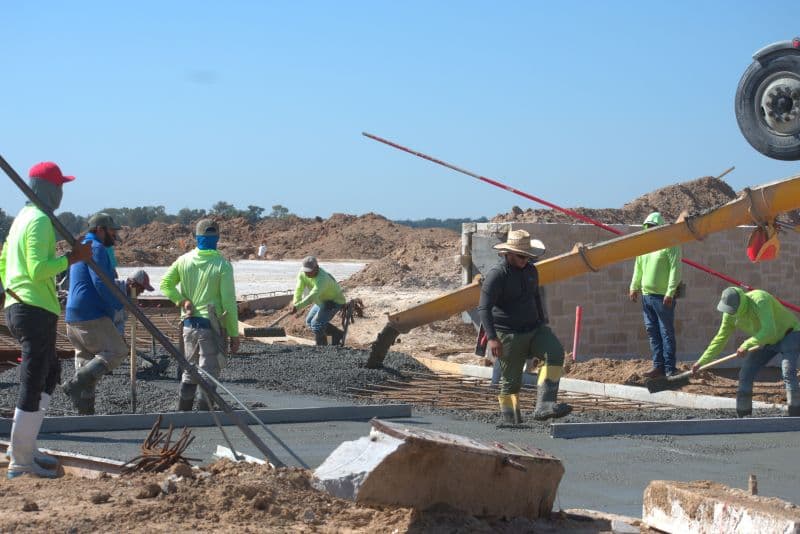
Why better positioning technology can make a significant difference in concrete construction profitability.
A Phone Call I Still Remember
I'll never forget a phone call I received from a client after helping introduce positioning technology into their construction operation.
He was shocked.
Not because something had gone wrong, but because of how much his concrete yields had improved.
His crews had been successfully placing concrete for years. But after implementing better positioning and grade control technology, he started noticing something different.
His actual concrete quantities were becoming more predictable.
That conversation reinforced something I've seen throughout my career working with contractors.
Some contractors already have better yields than others before implementing positioning technology. But regardless of where they start, better grade control creates an opportunity to improve material efficiency.
And those improvements can translate directly into profitability.
Why Concrete Yield Matters More Than You Think
When contractors estimate a concrete project, they calculate material quantities based on the designed area and thickness.
But what happens when the actual subgrade doesn't match the design?
A half-inch here. Three-quarters of an inch there.
Individually, these discrepancies might seem insignificant. Across thousands of square feet, they can add up quickly.
Consider a contractor pouring 100,000 square feet of concrete at a designed thickness of six inches.
The estimated quantity is approximately 1,852 cubic yards.
Now imagine the subgrade is consistently half an inch lower than intended.
That additional half-inch requires approximately 154 extra cubic yards of concrete.
At an illustrative cost of $175 per cubic yard, that's nearly $27,000 in additional material costs.
The contractor hasn't increased production or earned additional revenue.
They've simply purchased more concrete than the design required.
This is why accurate construction surveying and staking can play such an important role before material placement begins.
How Grade Control Technology Improves Concrete Yield
The purpose of grade control isn't simply to make a construction site more accurate.
It's to give contractors greater control over their operations.
Properly implemented grade control and machine control modeling help contractors establish consistent elevations, verify subgrade conditions, and identify discrepancies before they become expensive problems.
Better grade control can help contractors:
- Verify elevations before concrete placement.
- Reduce unnecessary overpour caused by low subgrades.
- Improve material quantity forecasting.
- Minimize corrective grading and rework.
- Maintain greater consistency across projects.
By combining accurate field measurements with digital terrain models and construction positioning systems, contractors can make decisions based on verified information rather than assumptions.
Not Every Contractor Starts With the Same Yield
One thing I've learned is that no two construction operations are exactly alike.
Some contractors already maintain excellent material yields using conventional methods.
Others have significant opportunities for improvement.
Their equipment, crews, existing procedures, and quality-control practices all influence the outcome.
But the underlying principle remains consistent:
Better control of grade means better control of quantities.
For contractors looking to modernize their operations, implementing site intelligence and positioning technology can be an important step toward improving consistency and protecting project margins.
The Return on Investment Goes Beyond Labor Savings
When contractors consider investing in construction technology, they often focus on productivity.
How much faster can we grade?
How many stakes can we eliminate?
How many additional acres can we complete in a day?
Those are important questions.
But material efficiency deserves just as much attention.
Reducing unnecessary concrete consumption across multiple projects can represent substantial savings over the course of a year.
And unlike productivity improvements that sometimes require additional work to generate returns, reducing material waste can improve profitability on projects a contractor has already secured.
The Real Value of Positioning Technology
That phone call from my client has stayed with me because it demonstrated something I've come to appreciate about construction technology.
The value isn't always found in what the equipment does.
Sometimes it's found in what the equipment prevents.
Unnecessary excavation.
Excessive fill.
Additional concrete.
Unexpected material costs.
At Civil Mesh Pro, we help contractors improve the way they build through accurate surveying, digital terrain modeling, construction staking, and positioning technology support.
Because ultimately, the objective isn't simply to build more accurately.
It's to build more profitably.
And sometimes the greatest return on technology is the material you never had to purchase.
Improve Your Construction Yields With Civil Mesh Pro
Better grade control starts with better information.
Whether you're looking to implement machine control technology, improve construction staking accuracy, or develop reliable digital terrain models, Civil Mesh Pro can help you identify opportunities to improve your operation.
Contact Civil Mesh Pro to discuss your next project.
For more information on construction technology and material efficiency, explore our construction insights and resources.
For another field perspective, read MM GPS: Does It Belong on the Grader, the Rover or Both?