
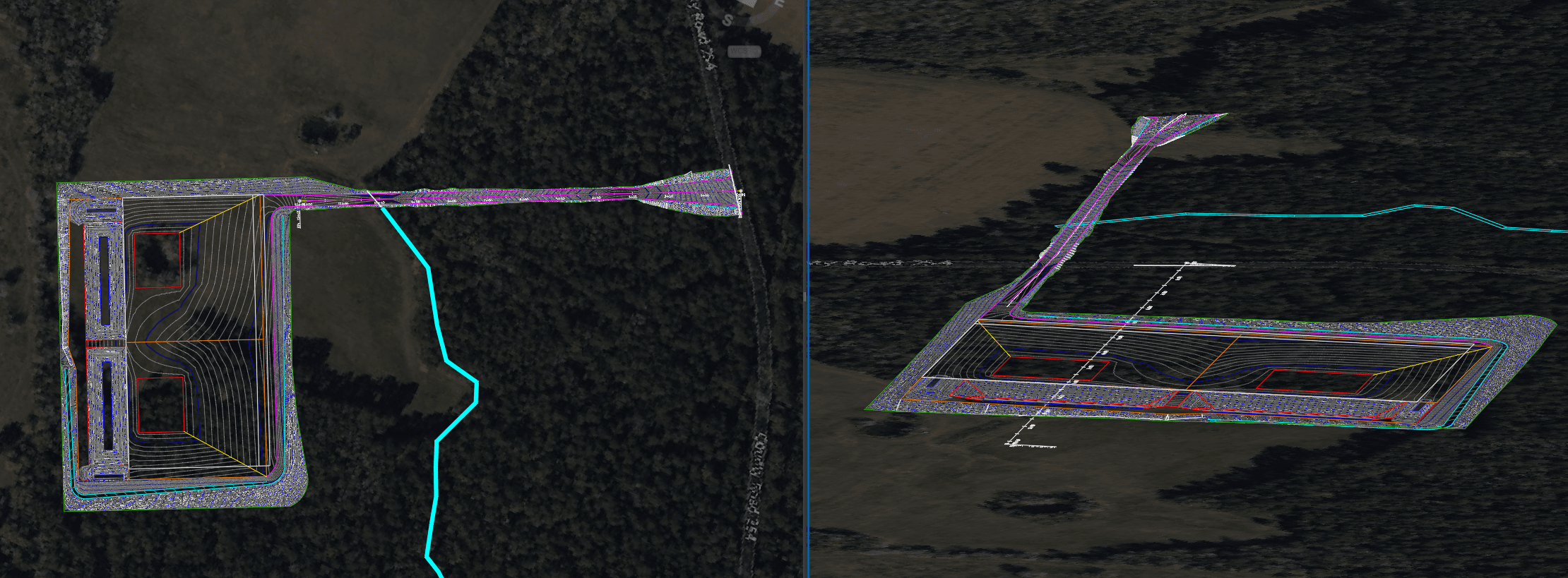
Before a blade touches the ground, someone needs to understand what that ground should become.
Plans communicate the design through elevations, contours, slopes, and details. A 3D machine control model translates that information into a digital surface that compatible equipment and field devices can use.
It gives the crew a target: where to cut, where to fill, and what elevation to reach.
But its usefulness extends beyond the operator’s screen.
What does the model actually do?
A machine control model typically contains a three-dimensional design surface and supporting linework identifying features such as building pads, roads, curbs, and drainage areas.
The machine’s positioning system determines where its blade or bucket is relative to that surface. Depending on the equipment, the system either guides the operator or automatically adjusts certain movements to help maintain grade.
The model supplies the target. The machine’s sensors and controls help the operator reach it. Topcon explains the basic operation here.
One digital foundation, several practical uses
The underlying surface data can support several jobs, provided it is prepared and checked for each purpose:
- Machine control: Give dozers, graders, and excavators the appropriate surface for the operation, whether that is rough grading, subgrade, or finish grade.
- Earthwork takeoffs: Compare existing ground with proposed surfaces to estimate cuts, fills, and potential import or export requirements.
- Grading plan audits: Examine slopes, transitions, drainage paths, and elevation relationships to identify questions before construction.
- Field grade checks: Help crews using compatible rovers compare measured elevations against the intended surface.
- Progress tracking: Compare new field measurements with earlier captures and the design to understand what changed and what remains.
These uses are related, but they do not always use identical deliverables. A takeoff needs quantity assumptions and boundaries. A machine needs compatible files and the correct working surface. An audit needs a careful review of the design relationships.
That is why Civil Mesh connects modeling, takeoffs, surveying, and grading audits within the same workflow.
Who uses a machine control model?
Operators use it to guide their work. Grade checkers use it to verify elevations. Estimators use related surface comparisons to develop quantities.
Superintendents and project managers use the information to plan phases, understand remaining work, and coordinate crews. Engineers and developers can use model-based reviews to discuss discrepancies before those discrepancies become field problems.
The value grows when the office and field are working from the same approved revision.
How long has this technology been around?
Machine control has developed over decades. Laser-based grade control came before the connected 3D systems familiar today. GPS-based machine control advanced during the 1990s, with increasingly capable positioning, software, and automation following.
This is established construction technology that continues to evolve. Trimble’s machine control history outlines that progression.
Why is demand growing?
As more contractors adopt 3D equipment, they also need dependable models to run it. Hardware alone cannot interpret every plan detail, resolve conflicting elevations, or determine which revision the crew should build.
Pressure to control costs, manage limited labor, and deliver predictable production adds to the case for connected workflows. However, adoption varies by contractor, equipment type, and market; there is no single growth rate that describes every jobsite.
Topcon’s research into adoption surveyed 1,000 construction decision-makers across Europe, highlighting both interest in machine control and barriers to wider use. Read the research overview.
Where do the efficiency gains come from?
The opportunity is in reducing repeated work:
- Fewer interruptions to understand the intended grade.
- Fewer unnecessary passes and corrections.
- Better control of over-excavation and excess material placement.
- Faster communication of approved design changes.
- Earlier identification of discrepancies that need review.
For example, preparing a concrete area to the correct subgrade can help avoid placing extra concrete into low spots. We explored that connection in The Hidden Profit in Concrete Yield.
Actual gains depend on the job, operator, equipment, positioning setup, and model quality. A model still needs verified control, correct units, current plans, and field checks.
The competitive advantage is better preparation
A contractor who understands quantities before bidding, resolves grading questions before mobilizing, and gives the field a dependable target has a stronger basis for controlling costs and protecting margins.
The advantage comes from connecting those steps consistently.
Our Mesh Method brings ground information, modeling, and verification together. And as construction advances, surface comparisons help measure progress and remaining earthwork.
Have a project coming up?
Share your plans, available survey information, and the machine control system your crew uses. Civil Mesh can help identify the modeling, takeoff, or grading review scope that fits the job.